
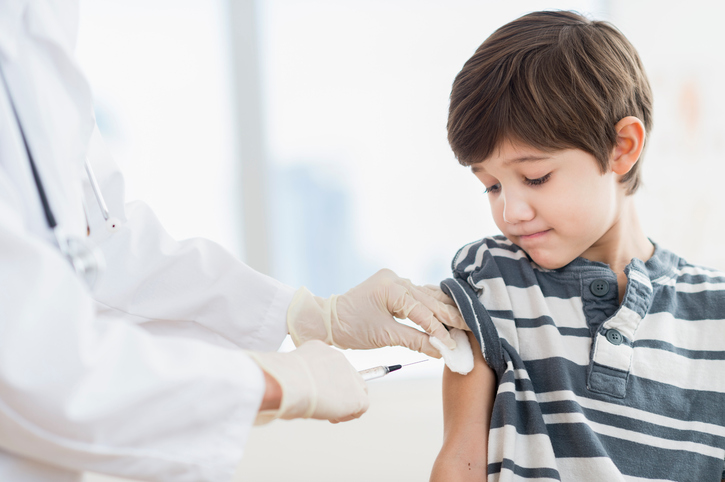
Shortly after birth, your baby should receive the first dose of the vaccine to help protect against conception of Hepatitis B.
This shot acts as a safety net, reducing the risk of getting the disease from you or family members who may not know they are infected with hepatitis B.
- If you have hepatitis B, there’s additional medicine that can help protect your newborn against hepatitis B; it’s called hepatitis B immune globin (HBIG). HBIG gives your child’s body extra help to fight the virus as soon as your baby is born.
At 2-3 years of age, your child should receive vaccines to protect them from the Influenza (every year)
Sometimes children have mild reactions from vaccines, such as pain at the injection site, a rash, or a fever. These reactions are normal and will soon go away.
Effective July 1, 2019:
Required vaccines to enter childcare (depending on age of first enrollment):
- Polio
- Diphtheria, Tetanus, and Pertussis (DTaP)
- Haemophilus influenza type B
- Measles, Mumps, and Rubella (MMR)
- Hepatitis B
- Varicella (Chickenpox)
Required vaccines to enter Kindergarten:
- Polio
- Diphtheria, Tetanus, and Pertussis (DTaP)
- Measles, Mumps, and Rubella (MMR)
- Hepatitis B
- Varicella (Chickenpox)
Required vaccines to enter 7th Grade:
- Tetanus, diphtheria, and pertussis booster (Tdap)
- Varicella (Chickenpox)
To prevent disease outbreaks in a community, at least 90% of its population must be immunized, depending on the disease. . If for any reason the parents choose not to vaccinate their child(ren), must provide documentation stating that the child will not be vaccinated for a particular reason. Personal belief exemptions will no longer be permitted beginning January 1, 2016. Personal belief exemptions submitted before January 1, 2016 are valid until the child enters kindergarten (including transitional kindergarten) or 7th grade. Valid medical exemptions from a licensed physician are not affected and will continue to be accepted. When parents choose not to vaccinate they put their children and others around their children at a great risk to various diseases that could have been preventable by a simple vaccination.
Herd immunity is present in a community when such a high percentage of its members have been immunized from a particular disease that the disease cannot gain a foothold in the community. Thus, achieving and maintaining herd immunity protects not only those who have been vaccinated, but also those with compromised or weak immune systems, such as the elderly, babies, and those afflicted with HIV. Religious and other exemptions to mandatory vaccination laws are not required by the U.S. Constitution. However, since 100 percent immunization rates are not needed to achieve herd immunity, most state governments have chosen to exempt certain individuals from their mandatory vaccination requirements, believing that communities can obtain herd immunity even if such individuals do not become immunized. Although many organized religions, including Catholicism and Judaism, do not prohibit vaccinations. Several smaller religious sects, most notably Christian Scientists and the Amish, oppose vaccination on religious grounds. Other individuals oppose vaccination for other reasons, ranging from non-religious philosophical or moral beliefs, such as a belief that vaccines interfere with “nature’s genetic blueprint”to unspecified personal reasons.
 Pro Vaccinations